
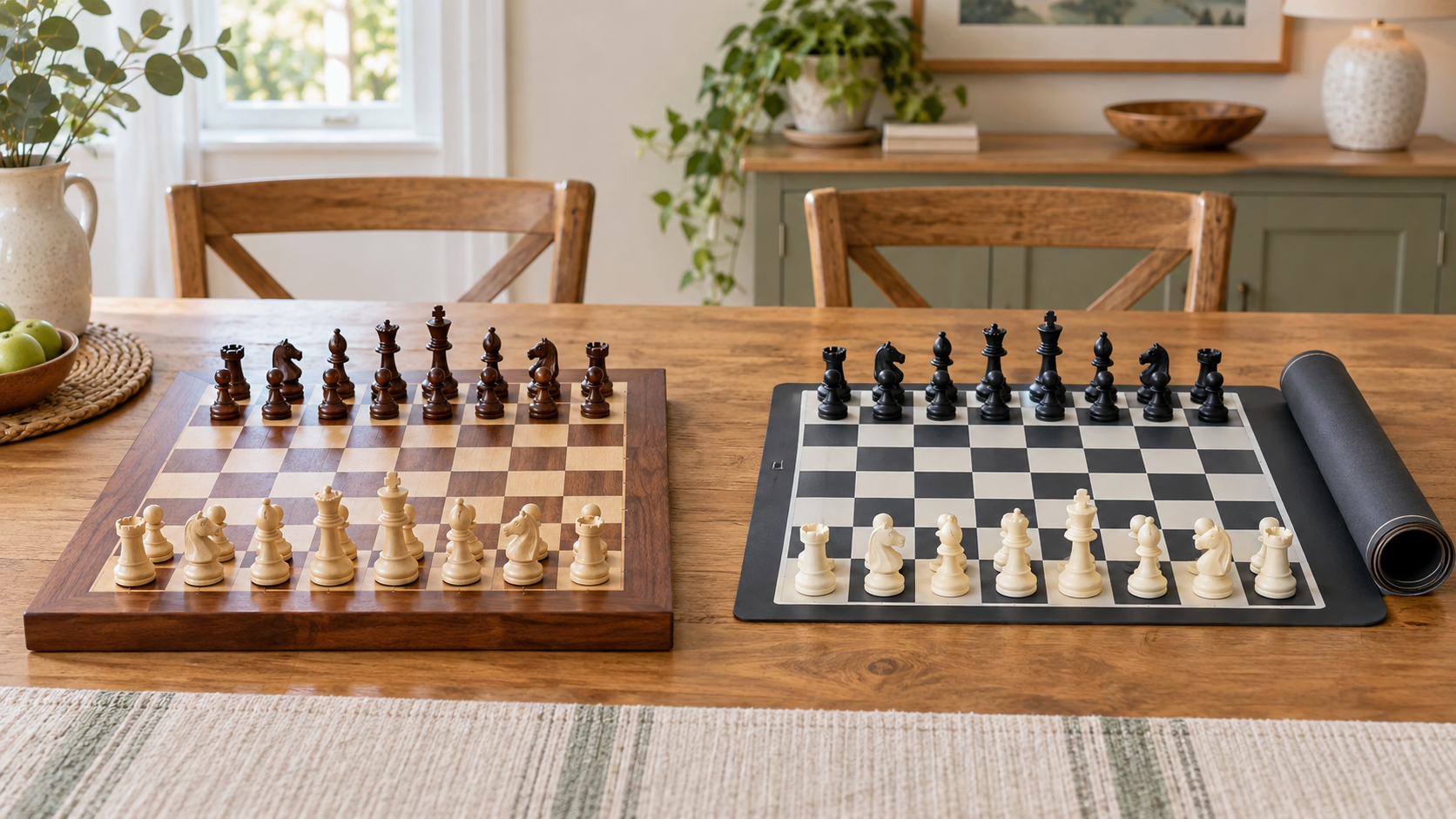
Choose a wooden board when your family wants a rigid, ready-to-display playing surface with a familiar table presence. Choose a silicone board when easy cleaning, flexible storage, and carrying the board between rooms matter more. Material alone does not settle the choice: square size, piece-base fit, contrast, stored shape, and the actual cleanup instructions matter just as much.
This is a board-surface decision, not a verdict on complete sets. If you are still choosing pieces and storage together, start with the beginner chess board guide or the broader family set checklist.
The Good Chess & Checkers may earn commissions from qualifying purchases.
Quick decision aid
Check the board, pieces, table, and storage together
Listings use material labels loosely. Verify the exact square size, overall dimensions, board thickness, coordinate markings, included pieces, carrying method, and maker's care instructions before buying.
Quick decision
- Choose wood for a stable board that can remain set up and whose finish suits the table and pieces.
- Choose silicone when spills, compact storage, or moving the board regularly are the main constraints.
- Delay the purchase until you measure the available table and the base diameter of the pieces you plan to use.
- Skip both categories if a folding board with built-in piece storage better solves the family's setup problem.
What a wooden board does well
A rigid wooden board establishes a flat playing surface without needing to be unrolled. It can stay on a table between games, and its frame and finish may suit a shared living space better than a training mat. A board that remains visible can also reduce the friction of starting a quick game.
The tradeoff is bulk. A one-piece board needs flat shelf or vertical-rack space, while a folding wooden board introduces a hinge and a stored thickness that must be checked. Wood finishes also have model-specific care limits. Do not assume a board tolerates soaking, household sprays, heat, or a damp storage area.
What a silicone board does well
A silicone board is flexible and can often be rolled for transport or storage. Its surface may suit a busy family table where the board is put away after each session. Many shoppers also consider silicone when wipe-down cleanup is important, but the exact maker's instructions still control what cleaners and temperatures are appropriate.
Flexible does not mean consequence-free. A tightly rolled or compressed board can be awkward to pack with rigid pieces, and a soft edge can extend into plates, books, or elbows. Confirm how the maker says to roll, wash, dry, and store it. Avoid assuming that every product sold as silicone has the same thickness, grip, odor, or heat tolerance.
Compare the details that affect play
Square size and piece fit
Measure a square and the widest piece base rather than relying on labels such as family size or tournament size. Pieces need enough room to be distinguishable without crowding neighboring squares. Set up kings, queens, bishops, and pawns in their starting rows to test the densest normal position.
Contrast and coordinates
Both materials can offer strong or weak contrast. Check the exact photos for clear light and dark squares under the room's normal lighting. Printed coordinates can help learners follow lessons, but tiny, decorative, or low-contrast labels may add clutter instead. Decide whether the family will actually use them.
Table behavior
A rigid board bridges minor table texture but can slide if its underside and the table are both smooth. A silicone board may grip well, yet its flexibility means crumbs or objects underneath can create bumps. Inspect the table, clear it before play, and use only a protective pad that does not make the setup unstable.
Setup and storage
A wooden board is quickest when it has a permanent home; it becomes less convenient when it must be lifted from a crowded shelf for every game. A silicone board reduces board-storage volume, but pieces still need their own bag or box. Compare the complete stored kit, not the board by itself.
Cleaning and maintenance
For wood, follow the finish maker's instructions and wipe spills promptly without saturating seams or hinges. For silicone, confirm permitted soap, water temperature, drying method, and whether the printed grid needs special care. Store either board fully dry and away from conditions the maker warns against.
Who each board fits
A wooden board fits a family with a reliable table or display spot, enough storage for a rigid object, and players who enjoy a traditional setup. It also makes sense when the chosen pieces have already been measured against its squares.
A silicone board fits a household that clears the table after every game, carries chess to another room or gathering, or wants a flexible surface that can be stored separately from the pieces. It works best when the family has a sensible rolling and drying routine rather than stuffing it into an overfilled bin.
Who should skip each option?
Skip a wooden board when its weight, rigid footprint, finish care, or lack of integrated storage makes regular play less likely. Skip a silicone board when players want a display piece, dislike managing separate piece storage, or cannot store it in the maker-recommended shape. Skip a new board entirely when the current board is readable, flat, complete, and large enough for the pieces.
Use a five-minute fit check
- Measure the usable table area and intended storage space.
- Measure the base of the largest pieces and compare it with the stated square size.
- Confirm the exact board material, dimensions, included items, and care instructions.
- Picture the complete routine: retrieve, flatten or place, set up, play, clean, dry, and store.
- Choose the board that removes the most frequent obstacle, not the one with the more impressive material label.
Next steps
Use the coordinates guide if labels are part of the learning plan. If the family needs one box for two games, compare a chess-only set with a chess-and-checkers combo set. For boards that must travel farther than the next room, use the travel set guide.
Bottom line
Wood favors rigid, ready-to-play presentation; silicone favors flexible handling, compact board storage, and a cleanup-oriented routine. The better family board is the one whose exact dimensions, square contrast, piece fit, care, and storage steps make it easier to play again.