
Learning basic chess notation is worth it for a casual beginner who wants to replay games, use books or lessons more easily, or ask specific questions about a position. It is not a prerequisite for enjoying chess. Learn it now if you already finish legal games and have a reason to record them; delay it while piece movement is still taking most of your attention; and skip formal recording if you only play relaxed games and never plan to revisit them.
“Chess notation” here means algebraic notation: a compact way to name squares and record moves. This guide is about whether the skill deserves your time, not whether you need to buy a scorebook, workbook, app, or other recording tool.
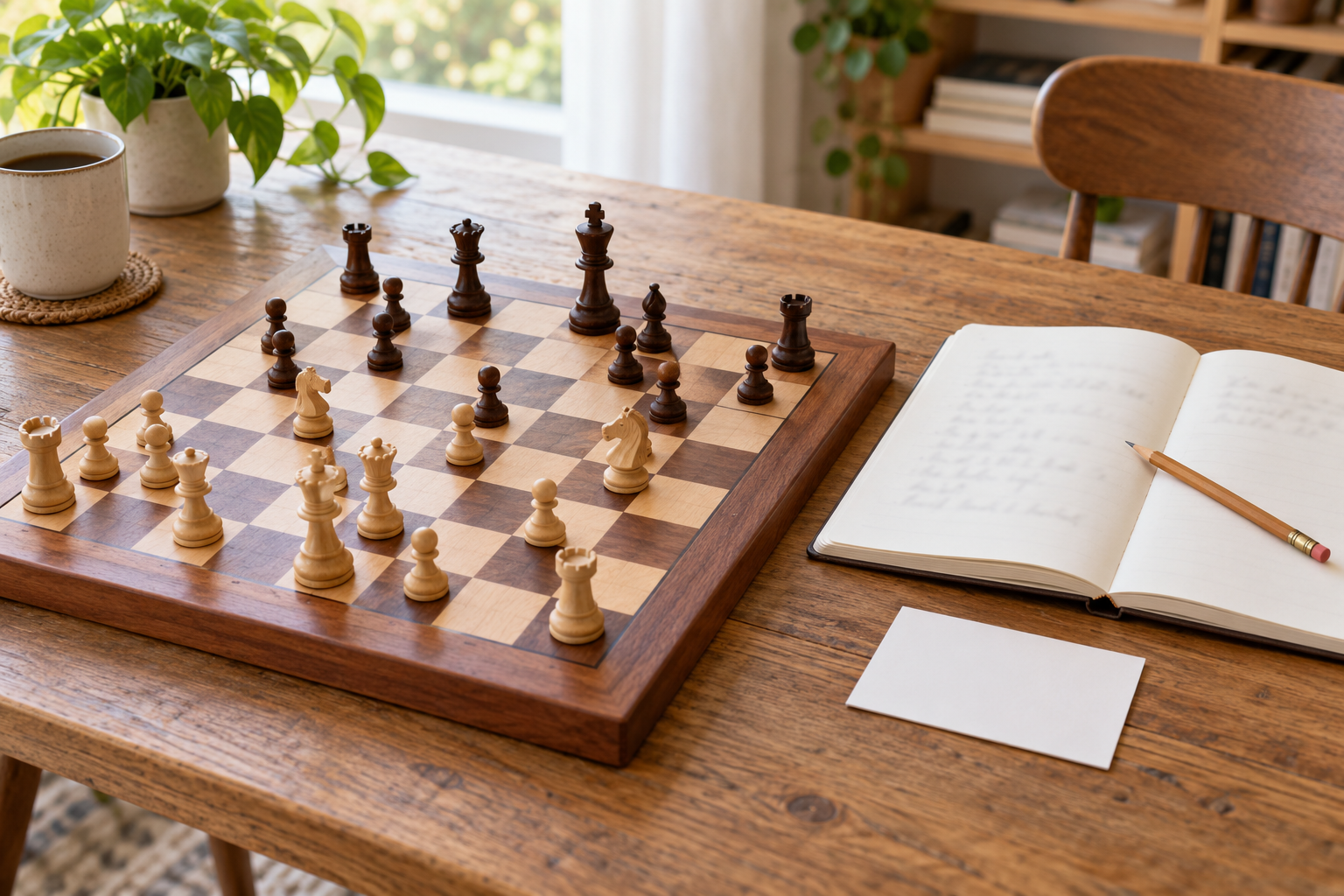
Quick verdict: learn, delay, simplify, ask, or skip
- Learn it now when you can make legal moves comfortably and want to replay complete games, follow written analysis, or discuss exact positions.
- Delay it when identifying legal moves, check, checkmate, or castling still needs most of your concentration.
- Simplify by learning the board coordinates first, then recording only a short practice sequence rather than a whole game.
- Ask the organizer before an event or club session if recording is expected, optional, supplied, or handled differently in that format.
- Skip formal notation when chess is purely social for you and a photo of the final position or a quick verbal recap meets your needs.
What notation actually gives you
Notation preserves the order of moves. That lets you rebuild a game, find where a plan changed, and show another player the exact position you mean. It also makes many chess books, annotated games, and lesson notes easier to follow.
The benefit appears only if you use the record later. Copying every move without replaying or discussing the game turns notation into clerical work. For many casual beginners, one reviewed game is more useful than a notebook full of untouched scores.
Use these criteria before spending time on it
| Decision check | Good reason to learn | Reason to wait or skip |
|---|---|---|
| Your goal | You want to replay games, study from written material, or bring positions to a teacher or friend. | You only want to move the pieces, talk, and start another casual game. |
| Rules load | Legal movement and check are already familiar enough to leave attention for writing. | Recording interrupts your ability to complete a legal move. |
| Review habit | You can name a time and method for replaying what you record. | The record will probably remain closed after the game. |
| Setting | Your lesson, book, club, or event uses notation and explains its expectations. | No current activity requires or benefits from a move record. |
| Friction | A pencil and plain sheet fit comfortably beside the board. | Writing space, time pressure, vision, handwriting, or motor comfort makes recording burdensome. |
Cost, setup, and maintenance tradeoffs
The skill itself costs nothing. Start with a plain sheet of paper and a pencil; a dedicated scorebook or app adds structure but is not necessary. The real cost is attention during the game and time afterward to check and replay the record.
Setup is small but specific: learn the files from a through h, the ranks from 1 through 8, common piece letters, captures, and the marks used for check and castling. Recording also needs maintenance. Correct unclear moves soon after the game, keep the page with a date or opponent label if that context matters, and discard records you will not use. If you later want a dedicated tool, compare that separate purchase with the chess notation scorebook decision guide.
Red flags
- A course or product treats notation as proof that someone is a serious or advanced player.
- You are told to memorize every symbol before playing another game.
- Recording causes repeated illegal moves, lost time, frustration, or less attention to the opponent.
- An event requirement is assumed from general advice instead of confirmed with the organizer.
- A paid workbook or subscription is presented as necessary before a free paper trial.
- You collect game scores but have no realistic review routine.
Who should skip it for now?
- A first-day learner who is still matching each piece to its legal movement.
- A casual player whose only goal is a relaxed game with family or friends.
- A child or adult for whom writing during play turns a pleasant game into a test.
- Anyone whose chosen app already stores moves automatically and who has no need to read or write notation elsewhere.
- A player preparing for a specific event who has not yet checked that organizer's current recording procedure.
A free 20-minute trial
- Use the beginner chess rules and piece-movement guide to make sure legal movement is already comfortable.
- Point to five random squares and name each one from its file and rank.
- Play six to ten moves from the starting position and write each move on plain paper.
- Reset the board, then try to rebuild the position from the record.
- Decide whether the replay answered a useful question. If it did, record one complete untimed game next. If not, return to playing and reconsider later.
Alternatives for the same goals
If you want to remember one position, take a board photo when the setting permits it. If you want post-game feedback, pause at one turning point and discuss it immediately. If written symbols are the obstacle, practise naming squares without recording moves. If you use an online board that stores games automatically, start by reading its move list rather than writing a second copy.
For practice materials, a focused exercise can help after the free trial; use the notation workbook decision guide to decide whether guided pages add anything beyond a free worksheet and board practice.
Bottom line
Basic chess notation is worth learning when it unlocks something you will actually do: replay a game, follow a book, communicate with a teacher, or meet a confirmed event expectation. It usually takes less equipment than beginners assume, but it does take attention and a review habit.
Learn it after legal movement feels comfortable, test it with paper before buying anything, and keep the process proportional to your goal. Delay or skip it when recording competes with learning the game or reduces the pleasure of casual play.