
Choose a chess puzzle book when a beginner benefits from a fixed sequence, quiet calculation, handwritten notes, and replaying positions on a physical board. Choose a puzzle app when immediate move checking, short sessions, and automatic position setup remove the biggest barriers to regular practice. Neither format teaches the rules by itself, and neither guarantees improvement.
This decision comes after the learner knows legal piece movement, check, and checkmate. If those foundations are still uncertain, start with how chess pieces move and play slow games before adding tactics practice.
The Good Chess & Checkers may earn commissions from qualifying purchases.
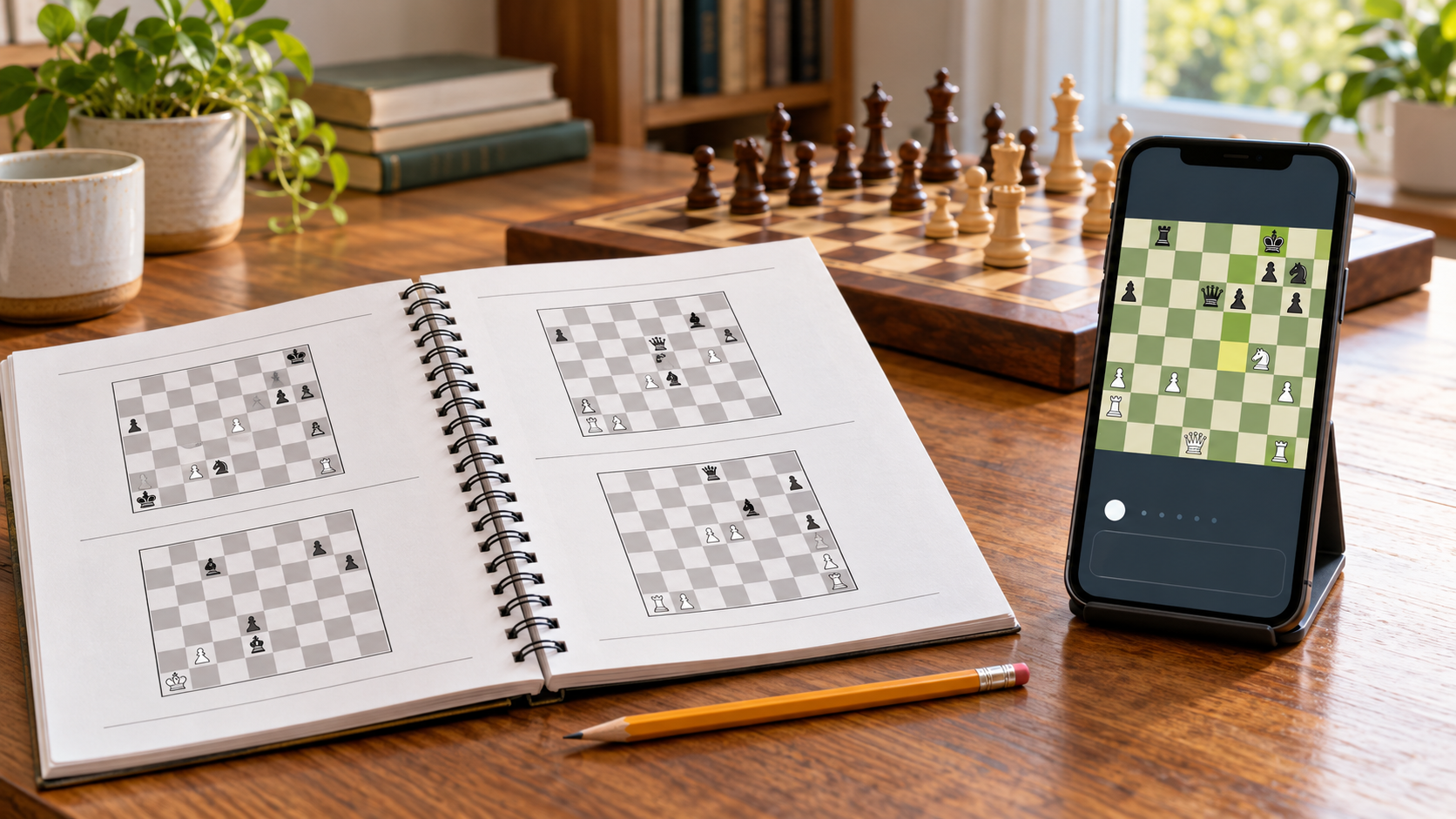
Quick decision aid
Preview the real puzzles before paying
For a book, inspect sample pages for diagram size, side-to-move labels, progression, and explained answers. For an app, use its free lessons or puzzles to check feedback, account requirements, device support, offline behavior, and current terms.
Quick decision
- Choose a book for screen-free study, a visible fixed path, notes on paper, and deliberate transfer to a real board.
- Choose an app for instant legality checks, automatic setup, short sessions, and a large supply of positions without storing another book.
- Use both only with separate jobs: an app for quick repetition and a book plus board for slower calculation and review.
- Skip both for now if the learner still guesses how pieces move, cannot recognize check, or would rather play complete untimed games.
Puzzle book vs puzzle app at a glance
| Decision | Printed puzzle book | Puzzle app |
|---|---|---|
| Setup | Open the page; a physical board is optional but useful | Position appears automatically on the device |
| Feedback | Check an answer section after calculating | Usually marks a move immediately; explanation depth varies |
| Sequence | Fixed and easy to preview | May be fixed, filtered, or adaptive; verify the current design |
| Focus | No notifications or account prompts on the page | Convenient, but shares a device with other distractions |
| Access | Works without power, login, or updates | Depends on device, app terms, and documented offline behavior |
| Best fit | Slow calculation and board transfer | Frequent short practice with immediate checking |
Who a printed puzzle book fits
A book fits a beginner who can hold a position in mind long enough to calculate before checking an answer. A fixed sequence makes progress easy to see, while margins or a notebook can hold candidate moves and mistakes. Placing the position on a board adds setup time, but it also makes the learner translate a flat diagram into the pieces used in ordinary games.
Preview the exact edition. Confirm that diagrams clearly show orientation and whose move it is, that early puzzles match the learner's level, and that solutions explain the idea rather than listing only a move. A thick collection is poor value when the opening pages are already too difficult or the answer key is too terse to diagnose a mistake.
Who a puzzle app fits
An app fits a beginner who is more likely to practice when the position is already set up and the next move can be checked at once. It can reduce the friction of resetting pieces, finding the answer page, and carrying a book. Filters or progress tracking may be useful, but only if those features are present in the current app and understandable to the learner.
Immediate feedback can also encourage guessing. A learner who taps several moves until one succeeds has not practiced the same calculation as someone who pauses, names candidate moves, and predicts the reply. Check whether the app explains why a move works, allows enough thinking time, shows the opponent's best response, and lets the learner revisit mistakes. Verify account, privacy, subscription, advertising, device, export, and offline terms directly; they can change.
Setup and maintenance differences
A book needs shelf space, adequate light, and a way to keep pages open beside the board. Mark answers lightly or use a separate notebook if another learner may use the same copy. Keep the book dry, and check whether a spiral, paperback, or hardcover binding fits the available table.
An app needs a compatible charged device and a stable stand or comfortable holding position for longer sessions. Notifications can interrupt calculation, so use the device's focus controls when appropriate. Confirm whether downloaded puzzles work without a connection and what remains available if a free trial or subscription ends. Do not assume saved progress transfers to another service.
Run a no-spend comparison
- Choose six beginner positions from a library book, a book preview, or another lawful source and solve three on paper or a physical board.
- Use three free puzzles in the candidate app without entering payment details.
- For every puzzle, pause before moving and write or say the intended move and expected reply.
- Record setup time, guessing, explanation quality, and whether the learner can replay one missed position on a board.
- Choose the format that produces a repeatable routine and useful review, not simply the higher puzzle count.
Who should skip each option?
Skip a puzzle book when the diagrams are too small, the answers are unexplained, the learner will not set up positions, or reading away from a screen is the main barrier. Skip a puzzle app when the device invites constant distraction, the learner rushes through feedback, the access terms are unclear, or the useful features require a commitment you have not tested. Skip buying either when a library copy, existing workbook, free app tier, or a coach's small set of positions already supports the routine.
Next steps
If the learner needs connected instruction rather than repeated positions, compare a chess book with an online course. If the goal is opening study instead of tactics, use the beginner opening-book guide. For a general first study book, compare beginner chess tactics workbook formats by sample pages, progression, and answer quality.
Bottom line
A puzzle book is the stronger fit for a fixed, screen-free sequence and deliberate board transfer. A puzzle app is the stronger fit for automatic setup and immediate checking in short sessions. Preview the real content, test both routines for free, and choose the format that makes the learner calculate before moving and understand mistakes afterward.