
A rigid chess board can take up most of a shelf when it lies flat, and stacking books or game boxes on its playing surface makes every retrieval more awkward. A vertical stand can give one empty board a defined parking place while keeping its face uncovered and accessible.
This guide compares stand categories and fit criteria rather than ranking named products. A stand should hold an empty, closed or one-piece rigid board; it is not a safe way to preserve an assembled position, and product dimensions and load limits must be checked on the current listing.
The Good Chess & Checkers may earn commissions from qualifying purchases.
Quick decision aid
Fit the slot to the complete board edge
Measure the board at its thickest point, then compare slot width, contact padding, base depth, divider height, capacity, and the clear space needed to lift the board out.
Start with the board, not the stand
Measure the board while it is empty and in the exact state you plan to store it. For a folding wooden board, close it fully and include hinges, latches, handles, feet, raised borders, and any uneven edge hardware. For a one-piece board, measure the thickest part of its frame rather than assuming the playing surface represents the edge.
- Thickness: the slot must accept the widest edge without forcing, scraping, or squeezing the board.
- Width and height: larger boards create more leverage above the stand, so listing compatibility matters even when the edge fits.
- Weight: confirm the maker's stated capacity instead of judging from appearance or material alone.
- Contact finish: look for felt, cork, foam, silicone, or another stated non-abrasive lining at every point that touches the board.
- Retrieval clearance: leave room above and in front of the stand to lift the board without striking a shelf or nearby object.
A loose fit is not automatically better. Too much slot clearance can let a tall board lean and shift; too little can rub the frame or prevent easy removal. Use published measurements and allow a modest working clearance appropriate to the lining rather than inventing a universal fit rule.
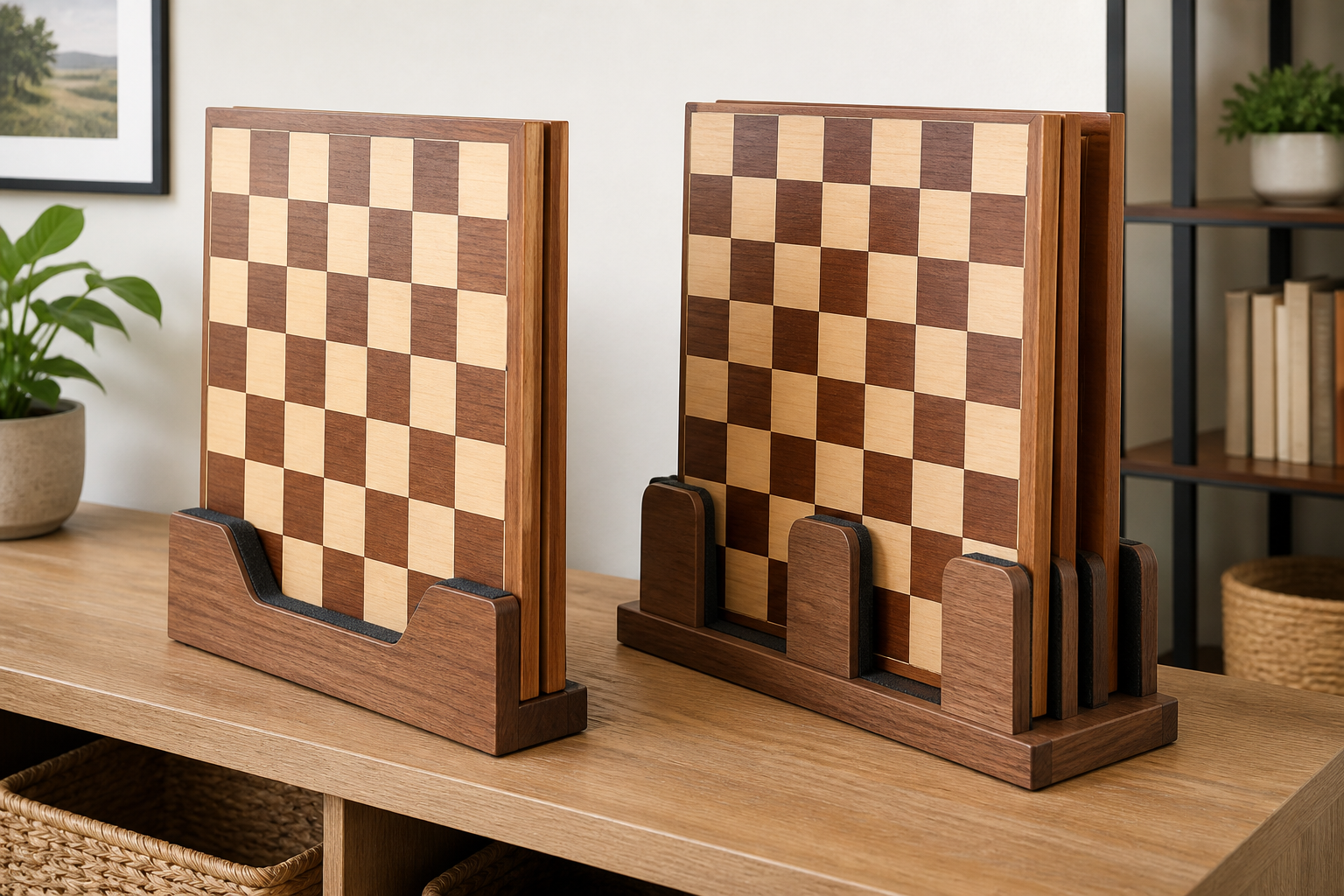
Best for one frequently used board: a padded single-board cradle
A low cradle with one lined slot is the simplest format. It keeps the board visible, uses no extra dividers, and can be easy to place beside a game table or on a sturdy shelf. Compare the footprint front to back: a broad base generally gives the board more support, but it also consumes more shelf depth.
Check whether the stand arrives assembled, whether fasteners protrude into the slot, and whether its feet sit flat. A tall backstop may guide the board more securely, while a very low lip puts more responsibility on the base geometry and board fit.
Best for: one rigid board that comes out often and has a consistent storage spot.
Skip it if: you need to store several boards, the stand's slot does not match edge hardware, or the available shelf is shallow or unstable.
Best for several rigid boards: a divided tabletop rack
A multi-slot rack separates boards instead of letting their playing surfaces rest against one another. Compare the number and width of usable slots, the padding on both sides of every divider, base depth, and how much room remains for your fingers when removing the middle board.
Capacity claims do not guarantee fit. Three slim flat boards and three thick folding boards are very different loads. Check each board against the current slot and weight specifications, and avoid filling an unused gap with loose objects that could shift or press against a board face.
Best for: a family, classroom helper, or casual club storing a small, known group of compatible rigid boards in one accessible place.
Skip it if: the boards vary widely in thickness, the rack becomes top-heavy when partially loaded, or people need to carry the boards to another location.
Best for furniture integration: a shelf divider or cabinet rack
A rack designed to sit within a cabinet can make good use of an existing game shelf. Here, the surrounding space matters as much as the stand. Measure shelf height, depth, lip or door clearance, and the path used to lift each board. Confirm that the shelf itself is level and suitable for the combined load.
Freestanding bookends and decorative plate easels may look similar in search results, but resemblance is not compatibility. Use only a stand whose listing supports the board's dimensions, weight, orientation, and intended storage use. Avoid improvised wall mounting or attaching hardware to furniture without appropriate product instructions.
Best for: boards that already live in a stable cabinet with enough overhead and front clearance.
Skip it if: a cabinet door, shelf edge, or low shelf forces the board to tilt sharply during removal.
Quick comparison framework
- Choose a single-board cradle for the smallest decision and fastest access to one board.
- Choose a divided rack when separate padded slots are verified for several rigid boards.
- Choose a cabinet-oriented rack only after measuring the entire retrieval path, not merely the empty shelf footprint.
- Choose a carrying bag or fitted box when the board travels, needs covered storage, or has loose pieces and accessories to keep together.
- Choose a board tube for a compatible roll-up board; do not force flexible storage advice onto a rigid wooden board.
Pre-purchase checklist
- Empty the board, close it if it folds, and measure its thickest edge, full width, full height, and weight.
- Compare those measurements with the stand maker's current slot, board-size, and load guidance.
- Identify every board-contact point and verify that each has an appropriate clean lining.
- Measure base width and depth, plus the shelf or tabletop area and overhead retrieval clearance.
- Check assembly steps, fasteners, feet, divider spacing, and whether the rack must be loaded in a particular order.
- Plan separate storage for pieces, clocks, scorebooks, and other accessories; do not wedge them into a board slot.
- Place the stand where it will not be bumped, pulled by a cord, exposed to moisture, or used as a handhold.
If a club stores several rigid boards rather than one home board, compare a multi-slot rack with a supported flat shelf before choosing an organizer. Retrieval order and board-specific care guidance may matter more than nominal rack capacity.
Who should skip a vertical chess board stand?
Skip this category if your board is flexible, regularly transported, unusually heavy, warped, fragile, or fitted with edge hardware that prevents an even seat. A roll-up board tube, fitted case, original box, or horizontal shelf may suit those constraints better.
Also skip it if the only available location is a narrow high shelf, an unsteady table, a busy passage, or a spot where children or pets could pull the board forward. A retail storage stand is organization furniture, not a display case, security device, conservation system, or substitute for responsible placement.
Bottom line
For one frequently used rigid board, start with a padded single-board cradle whose slot, load guidance, and base match the complete board. Use a divided rack only when every board fits its own lined slot and the combined setup remains stable and easy to unload. Measure the storage location and retrieval path, keep pieces elsewhere, and choose covered storage when portability or enclosure matters more than instant access.